“Take” a Good Impression… and Transform Your Professional Relationships

Starting a new role, especially at a senior level, often comes with the pressure to add value quickly and “make a good impression”. We often obsess about how we present ourselves, how we can impress, produce immediately and be seen as a great addition to the team. But what if the secret to making a lasting positive impression isn’t about focusing on how we are perceived by others, but rather, about first truly understanding and absorbing what others need and expect, so that we can apply our skills and experience more effectively?

The Origin of “Making a Good Impression”

The phrase “make a good impression” originates from the world of printing. In the early days of printing presses, the quality of the printed material depended heavily on making a good impression of the type onto the paper. This meant pressing the inked type firmly and evenly so that the ink would soak in properly, creating a clear and lasting mark. A poor impression meant a blurred or uneven print, failing to convey the intended message.

In our professional lives, particularly at mid to senior levels, we often approach new roles and relationships with the mindset of that printing press, focusing on how we can stamp our image, skills, and personality onto the new environment or context. However, the true art lies not in how forcefully we make our mark, but in how well we are able to make a meaningful contribution in light of the context, which requires us to first take in the impressions around us.
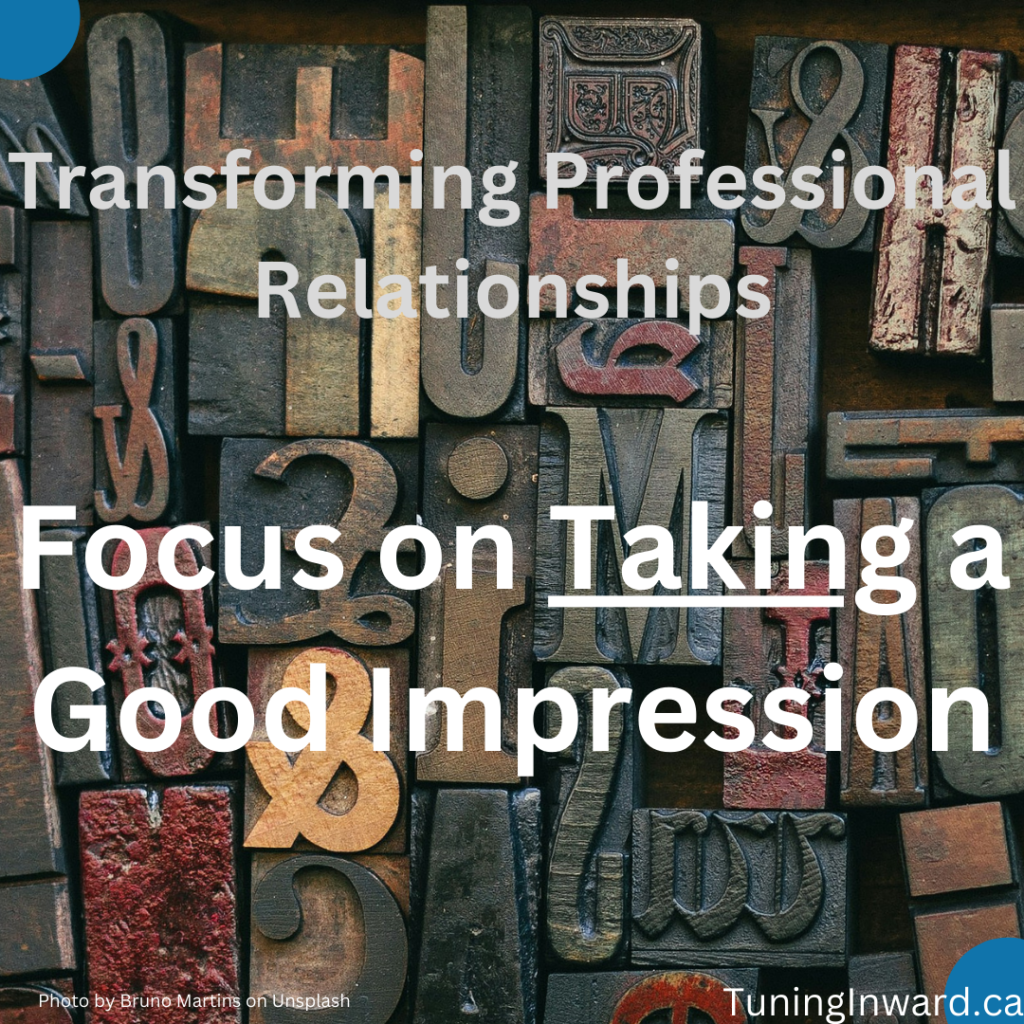
Reframing Our Approach: Taking a Good Impression

How do we shift our perspective to taking a good impression? This means actively engaging with and understanding our colleagues, clients, and leaders. It involves listening, observing, and absorbing the culture, needs, and expectations of our new environment. This approach not only fosters deeper connections but also builds trust and lays the groundwork for long-term success.

Examples of how we can do this:

1. Prioritize Listening and Observation

Taking a good impression starts with listening more than you speak. Pay attention to the way people communicate, the values they express, and the goals they prioritize. Observe how your colleagues interact, the dynamics within teams, and the overall company culture. Take note of key phrases, recurring themes in meetings, and the informal ways people interact. This will help you understand the underlying currents of your new workplace.

2. Understand Needs and Expectations

Everyone has unique needs and expectations, from your immediate team members to your clients and upper management. By understanding these, you can tailor your approach to meet them effectively, demonstrating that you value and respect their perspectives. Schedule one-on-one meetings with your key colleagues and stakeholders. Use these meetings to ask open-ended questions about their challenges, goals, and expectations. This will give you important insights into how you can support and collaborate with them. When you make an effort to understand and share the feelings of your colleagues and clients, it creates a foundation of trust and mutual respect.

3. Adapt and Integrate

Being adaptable is crucial. This doesn’t mean losing your identity, but rather finding ways to align your strengths and skills with the needs of the organization. Flexibility and openness to feedback are key. Show that you are willing to adapt and integrate into the existing processes and culture, and make improvements from that base of understanding.

Conclusion

The traditional approach of making a good impression focuses on the outward expression of our best selves. However, by reframing our approach to taking a good impression, we shift the focus to understanding and integrating into our new environment so that our contributions are tailored and, thus, more meaningful to the context. This deeper connection not only helps us build trust but also naturally leads to making a good impression in a more meaningful and lasting way, as we can create stronger, more trusting connections that pave the way for long-term success.

Preventing Team Spaghettification: Keeping Your Team From Coming Apart Under Pressure

My toddler niece is deep in a space phase, which means I’ve been learning a lot more about phenomena like black holes lately. That’s how I came across the concept of spaghettification—a real astrophysics term for what happens when something gets pulled toward a black hole and is stretched so thin, it starts to unravel.

That’s what a lot of team check-ins sound like right now.

People aren’t just busy—they’re being pulled in too many directions at once. Across files, clients, deliverables, shifting leadership, organizational change, unclear roles, and moving targets. Just like matter approaching a black hole’s horizon, capable professionals are doing their best to hold it all together, even as the systems around them fray.

Teams are caught in relentless gravitational pulls.

And while capacity is part of the story, what I often see underneath is more structural and systemic. It’s about missing clarity that leaves people guessing. It’s unspoken assumptions that create misalignment. It’s poor handoffs where accountability gets lost. It’s too much work happening in the shadows or being duplicated because visibility is low.

As a result, more workload dashboards won’t necessarily solve the stretch.

Instead, let’s explore a few key areas I’ve helped client-serving teams address when they feel like things are starting to unravel:

1. Streamlining intake

How work enters the team—how it’s assigned, briefed, and launched—sets the tone for everything else. If your team is spending time chasing down missing information, guessing what’s urgent, or duplicating each other’s efforts, the problem of volume intensifies.

A clear, shared intake process could help turn this around. Even a few small changes—like a standardized checklist, a mandatory kickoff, or a shared documentation template—can reduce frustration and eliminate unnecessary follow-up work.

2. Efficient escalation

When team members aren’t sure if it’s “worth bothering” someone senior, they’ll often try to work through it on their own—even when they’re stuck. That hesitation, especially in fast-moving environments, can quietly rack up hours of wasted time and energy.

Creating efficient (and psychologically safe) escalation paths is key to preventing this waste. This goes beyond just telling people to ask questions—it means designing when, how, and to whom they should escalate issues, so they don’t lose time wondering or over-functioning alone.

3. Ownership and accountability

I’ve seen this go sideways in a few ways.

Something falls through the cracks and no one realizes it until it’s too late. Or a task that was assumed to be done quietly stalls out because no one was actually on it. Or someone thinks they have completed the task, but that is seen as incomplete or not to standard by the receiver.

Clear ownership isn’t about micromanaging. It’s about surfacing who’s responsible for what—and creating space for the handoffs, follow-through, and status checks that keep things moving without excessive oversight.

4. Clear instructions—and clarity from the client

Rework is expensive. Most teams don’t talk about how much time they lose to unclear directions, vague expectations, or conversations that end with “I thought you meant…”

A short conversation to align on scope, format, tone, and level of polish can prevent late-night rewrites and frustration on both sides.

Just as importantly, leaders and client-facing team members need to clarify with the client what’s actually needed—and how they want it delivered. Otherwise, the team risks delivering something that’s technically excellent—but still misses the mark.

5. Prioritization (Real, Not Performative)

Everything can’t be urgent all of the time.

In teams managing multiple clients or projects, urgency can feel constant. But it is impossible to handle everything at once.

Where I’ve seen teams regain control is in learning to distinguish what truly needs to be done first. That might mean breaking things into milestones, triaging together, and intentionally planning for what happens when priorities inevitably shift.

If no one is making those calls out loud, the loudest voice usually wins—and strategy quietly disappears.


These aren’t the only conversations worth having. But they’re a few that tend to change the game when client delivery feels unsustainable.

It starts by naming the forces pulling us apart—and choosing where to focus, together.

Teams can be designed to withstand the gravitational pressure—without unraveling into organizational spaghetti.

Because delivering excellent client work shouldn’t rely on late-night heroics or quiet strain.

If your team is feeling the stretch, let’s talk. I’d love to hear which of these challenges resonates most with your experience.

Streamline Your Work: The Smartest Goals Start with Subtraction, Not Addition

“If only I could take this off my plate…”

We’ve all had that thought this year. Whether it’s the 10th routine contract review of the week with the company name misspelt, the endless back-and-forth for client or deal details, or rewriting the same time entries over and over, these small inefficiencies add up.

Why Goal Setting Often Fails: The Goal-Setting Trap

streamline business processes with goal setting

This time of year, goal-setting conversations tend to focus on adding more—higher targets, bigger wins, increased output. But addition doesn’t always equal progress.

5 Strategies to Reduce Workplace Inefficiencies and Free Up Time

In my work with clients, we focus on identifying the small, recurring inefficiencies that distract teams from high-value work.

Here are five shifts you can make to do less of what drains you:

✅ Streamline Contract Reviews and Proofreading:

Leverage clear templates, modification guidelines, and accountability structures so routine contracts can move forward independently by the business.

✅ Automate Docketing with Ready-to-Use Templates:

Save time with narrative scripts that are ready to use and easy to customize.

✅ Eliminate Pointless Check-Ins: 

Replace status meetings with real-time dashboards or shared documents that keep everyone aligned.

✅ Simplifying Information Intake Processes:

Create a simple intake form that collects essential client or deal details upfront—party names, dates, pricing, and term lengths—so you can skip the back-and-forth.

✅ Simplifying Knowledge Sharing:

Avoid “reinventing the wheel” by maintaining a shared library of best practices, sample clauses, and templates for recurring tasks.

The Payoff

By clearing workplace inefficiencies and distractions off your plate, you open up space for what truly matters:

💪 Deeper client relationships.

💪 Complex, high-value work.

💪 Collaboration and creativity that move teams forward.

Sometimes the smartest goals are about subtraction—doing less of what drains us so we can focus fully on what matters most.

Imagine looking at your plate in 2025 and seeing only what truly moves the needle.

What inefficiency will you subtract in 2025 to focus on what matters most?

If you’re ready to identify and eliminate what’s draining your team, let’s connect. Together, we can focus on what truly moves the needle in 2025.

Effective Feedback Essential to Retaining High Performers

Feedback is often hailed as the cornerstone of professional development. It’s what helps employees grow, refine their skills, and advance in their careers.

However, recent insights from a comprehensive report by Textio, which analyzed performance reviews for over 23,000 workers across 250 organizations, reveal that not all feedback is created equal—and the implications for employee retention are profound.

Differences in Feedback Across Genders

One of the most striking findings from Textio’s analysis is the gender disparity in the type of feedback men and women receive.

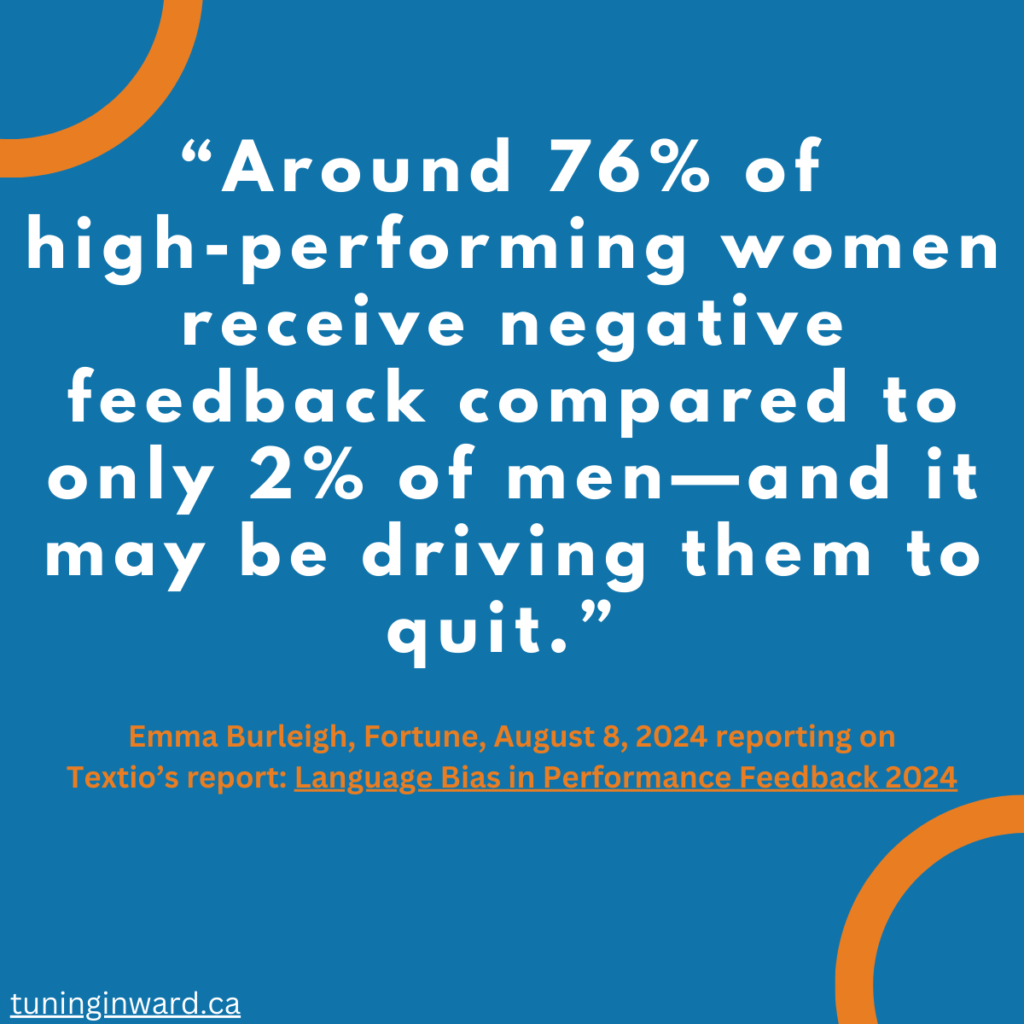
Kieran Snyder, cofounder and data analyst for Textio, tells Fortune this has largely to do with managers’ unconscious bias—women are judged more critically, and on a more personal level than men. “It’s a pattern that is not often checked,” she says.

Men are predominantly given developmental and constructive feedback that focuses on their work and professional achievements. This type of feedback is crucial because it provides clear, actionable insights into how they can improve and advance in their careers.

In contrast, women’s feedback often centers on their demeanor, personality, or disposition, rather than their work. For instance, instead of recognizing a woman’s successful completion of a significant project, Textio found that her performance review might describe her as “a joy to work with.”

While positive feedback is important, when it’s detached from the actual work done, it diminishes the value of the woman’s contributions and can stifle her career growth.

The Problem with Unactionable Feedback

Another concerning trend revealed by Textio’s analysis is the prevalence of unactionable feedback, particularly for women.

Unactionable feedback is vague, non-specific, and fails to provide clear guidance on how the individual can improve. This type of feedback is not only unhelpful but can also be demoralizing. It sends a message that their contributions are not fully valued, and can leave employees without a clear path forward, leading to frustration and disengagement.

High-performers, who are often ambitious and driven, crave clear, specific feedback that they can use to propel their careers forward. When employees receive actionable, constructive feedback that acknowledges their achievements and provides clear guidance on how to improve, they are often energized and motivated to stay. They see a path for growth within the organization and are more likely to remain loyal, contributing to the company’s long-term success.

When they don’t receive it, they are more likely to seek opportunities elsewhere—especially since they are often highly sought after by other organizations.

Effective Feedback is Critical for Retention

Low-quality feedback damages employee morale, especially for high-performers who thrive on growth and improvement. According to the analysis, around 40% of top performers who receive unactionable criticism consider leaving their companies. This is almost double the rate of those who receive actionable, constructive feedback.

High-performing employees drive innovation, inspire their teams, and consistently deliver results. They even positively impact the productivity of workers around them. Michael Housman and Dylan Minor of Northwestern University looked at the 25-foot radius around high performers at a large technology firm and found that these workers boosted performance in coworkers by 15 percent! This makes high performers even more critical to retain.

Empowering Leaders to Deliver Effective Feedback

As the data from Textio’s analysis clearly shows, the quality of feedback can have a significant impact on employee retention. By prioritizing clear, actionable, and equitable feedback, organizations can ensure that their best performers remain engaged and committed for the long term.

Leaders should focus on delivering feedback that is specific, actionable, and tied directly to the work being done. Recognition and rewarding of achievements should be based on performance, rather than personality traits. Additionally, organizations should regularly review their feedback processes to identify and address any biases that may exist.

Creating a culture of effective feedback is not just about improving individual performance—it’s about retaining top talent and fostering an environment where all employees can thrive.

The insights from Textio’s analysis provide a clear call to action for organizations: prioritize effective, actionable feedback to retain your top talent. In a competitive job market, where high-performers have numerous options, the quality of feedback they receive can make all the difference in whether they choose to stay or go.

Let’s connect if you’re interested in discussing how to give or seek out effective feedback!

Unlocking Doors?: Considerations for Your Mid Year Review

In a talk I did in January reflecting on the upcoming year, I used the inspiring analogy of unlocking doors. Every milestone gives us an opportunity to consider and choose the doors we want to open (and those we may want to close), as well as the keys we could use to unlock them.

As we sit at the mid year point of the year, let’s take a moment to reflect on what we want to unlock in our career and our lives.

Photo credit: Karsten Winegeart @ Unsplash

There are so many options we all have: multiple doors leading to different paths, including personal, family, career, and personal goals. And in our hands, a bunch of keys, such as skills, knowledge, mindset, and inspiration, that have the potential to unlock a new adventure, a hidden talent, a deeper connection.

The beauty of this analogy lies in its richness and depth. It reminds us that:

We have agency

Through our focus and attention, we choose the doors we approach, the skills we sharpen, and the challenges we embrace.

There are multiple potential keys at our disposal

The solution to a challenge rarely lies in a single approach. Flexibility and resourcefulness are our allies. Some keys we may already possess, while others we need to forge along the way.

The journey is transformative

As we unlock new doors, we shed old versions of ourselves and embrace the unknown, growing and evolving with each step.

One door I’m focusing on is deeper connection – with clients, colleagues, loved ones and myself. I plan to use keys of focus (and saying no), curiosity (to listen harder) and being ok with discomfort (and doing things that are hard for me sometimes).

Whichever doors you find yourself focused on: whether grand, imposing, weathered or unassuming, I wish you the best in unlocking your dreams, overcoming challenges, and unveiling possibilities!

Flipping the Script – Using Feedback as Fuel

We’ve all been there: sitting across from a supervisor during a performance review, heart pounding, as they offer constructive criticism. It’s a moment filled with tension and vulnerability, often leading to a defensive mindset.

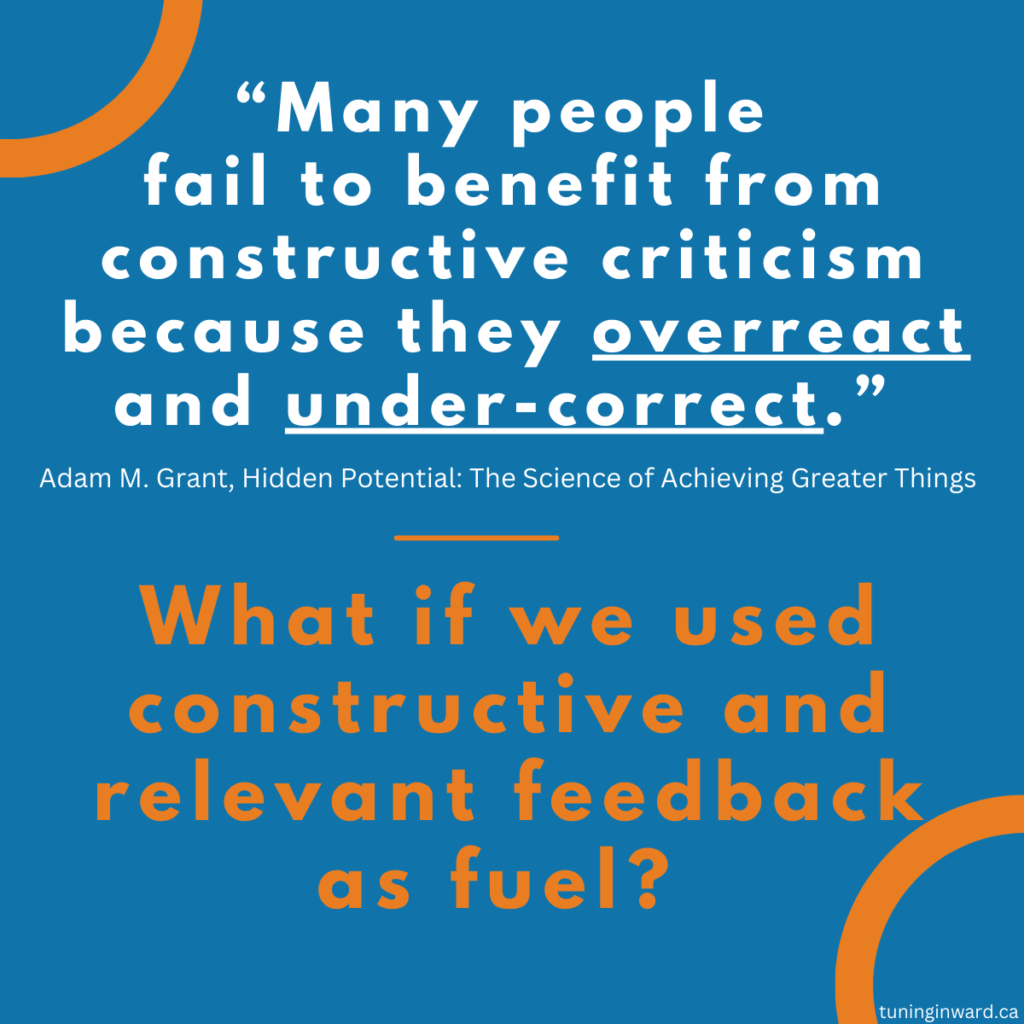
Adam Grant perfectly captures the trap we fall into: we feel defensive and attacked so we over-react, which leads to a tentative, hesitant under-correction that leaves the potential for growth unrealized.

But what if we flipped the script?

Instead of seeing feedback as fire to extinguish our confidence, what if we viewed it as fuel to propel our progress?

What if we approached it with curiosity – seeking clarification, asking for specific suggestions?

Asking “how can I” to spark new ideas and give light to areas for specific action?

Reframing Feedback: From Fire to Fuel

The first step in transforming feedback into fuel for progress is changing our mindset.

Feedback, especially when it is constructive, can be a gift, offering us insight into how others perceive our work and providing specific areas where we can improve.

By reframing feedback in this way, we can shift from a place of defensiveness to a place of openness and curiosity.

Embracing Curiosity

When we receive feedback, our initial reaction might be to defend ourselves or dismiss the critique. Instead, we could take a moment to breathe and ask questions to understand the feedback fully.

For example, if a supervisor or senior partner points out that your memos lack clarity, inquire further: “Can we go through an example?” or “Can you walk me through which specific aspects you think need improvement?”

Broader questions may also be helpful to spark new ideas and action plans. Questions like: “How can I improve in this area?” or “What steps can I take to meet your expectations more effectively?” can be incredibly powerful. These questions show that you are proactive and committed to continuous improvement. They also encourage the feedback giver to provide specific suggestions, which can be more helpful than vague critiques.

By seeking clarification, we not only gain a better understanding of the feedback but also demonstrate our willingness to learn and grow. This approach can also help in identifying actionable steps to address the feedback, making the process more constructive and less daunting.

Developing an Action Plan

Once you have a clear understanding of the feedback and have asked the right questions, the next step is to develop an action plan.

This plan should include specific, measurable goals and a timeline for achieving them. For example, if the feedback is about improving your communication skills, your action plan might include attending a communication workshop, seeking out a mentor, or practicing public speaking regularly.

An action plan not only provides a roadmap for improvement but also helps in tracking your progress. Regularly reviewing and adjusting your plan ensures that you stay on track and continue to make progress.

Embracing Growth

Ultimately, the way we respond to feedback can significantly impact our personal and professional development. By viewing feedback as fuel rather than fire, we can transform moments of criticism into opportunities for growth. In doing so, we not only improve our own performance but also contribute to a more dynamic and innovative workplace.

How might you make the most of constructive criticism?

How to Let Go and Move On: Embracing Federer’s 15-Second Routine for Professional Success

Tennis legend Roger Federer’s recent viral (and excellent!) commencement address at Dartmouth College shared much wisdom.

One of the most shared extracts related to the theme of when you lose. He said:

The truth is, whatever game you play in life, sometimes you’re going to lose…The best in the world are not the best because they win every point…It’s because they know they’ll lose…again and again…and have learned how to deal with it.

We often hear about how important it is to move on or make the most of a failure; unfortunately, however, how to do it effectively is more elusive.

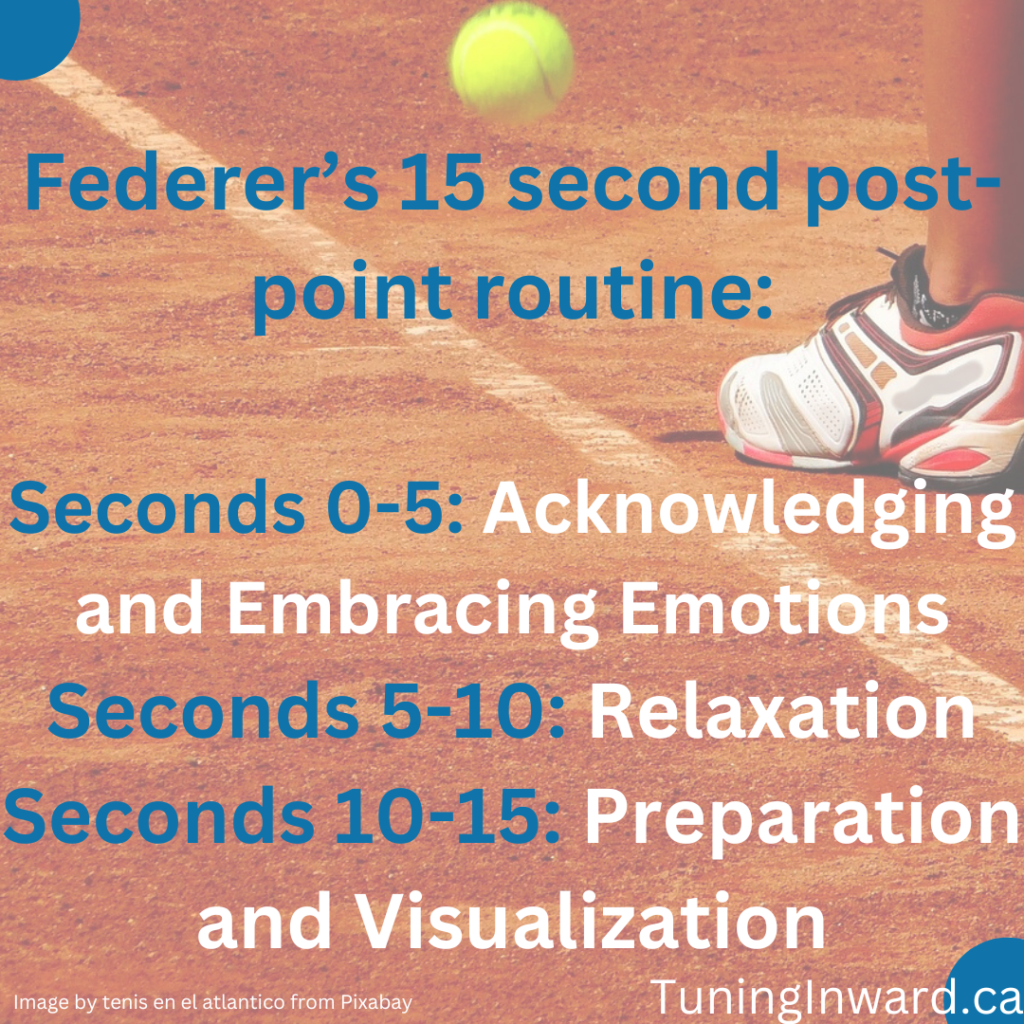
Prior to his farewell match at the Laver Cup in 2022, Federer shared his 15-second routine between points. His meticulously crafted routine is not just about physical readiness but, perhaps more importantly, about the power of mental agility and resilience.

I think his process is quite effective beyond sports, including in professional (and personal) domains, especially when we take advantage of being off the tennis court, as it permits us to take more than a few seconds for each stage.

Seconds 0-5: Acknowledge and Embrace Emotions

Federer begins his routine by dedicating the first five seconds to the emotions he is experiencing: recognizing, acknowledging and embracing them. He says: “Point to point, my feelings can change a lot, so it’s important I’m aware of them so that I can either hold onto, or let go of, that feeling for the next point.”

For professionals, this step can be pivotal after a heated negotiation or a critical feedback session. Taking a few moments to identify and acknowledge your emotions—be it satisfaction, frustration, elation or disappointment—can prevent these feelings from clouding your judgment. It’s about giving yourself the permission to feel without letting those emotions dictate your next move.

Seconds 6-10: Relaxation

The next five seconds in Federer’s routine are dedicated to relaxation. Regardless of the outcome of the previous point, he focuses on calming his mind and body, primarily through breathing exercises. This phase is crucial as it helps transition from an emotional response to a state of calm readiness.

In a professional setting, particularly after or before intense or high-stakes discussions, taking a moment to relax can reset your mental state. Simple breathing exercises (such as box breathing) or a brief mindfulness practice (such as taking 90 seconds to focus on one of your physical senses with deep attention) can help dissipate tension and bring you back to a balanced state. This relaxation phase ensures that you approach the next task with a clear and focused mind.

Federer recognizes this can be challenging in the moment, so he emphasizes keeping it simple: “To be able to relax when the occasion is big and the pressure is high is a difficult thing to do. So, I keep it simple and focus on my breathing and relaxing the muscles in my body.”

Seconds 11-15: Preparation and Visualization

It is only after the first two phases that Federer moves into preparation for the next point: “Only when I’m ready will I go into this phase.” This last phase is about planning the strategy for the next point – and he does this through visualizing his actions and the desired outcome. He says:

“This is when I plan my plan of action for how I want to start the point and how I would like it to finish. This is through visualization. I will plan where I’m serving and my next shot. From there I will visualize how I see the point finishing in my head. This gives me confidence and a feeling that I’m in control. Now, I’m ready to start the point.

This mental rehearsal builds his confidence and gives him a sense of control.

For professionals, this is the phase where strategic thinking comes into play. After moving ourselves out of a stress response, our body and mind are primed to think critically: allowing us to be both tactical and strategic. Plan and visualize the desired outcome of your next action, whether it’s a follow-up meeting, a critical decision, or an important presentation. This mental preparation can enhance your confidence and readiness, allowing you to tackle the task with a clear and positive mindset.

Summary and Plan of Action

Federer’s 15-second routine is a powerful tool that professionals can adapt to improve their effectiveness and resilience.

Here’s a simple framework modified to allow for slightly more time at each phase to incorporate this routine into your professional life:

  1. Be aware of and acknowledge your emotions (2 minutes): After a challenging interaction or receiving feedback, pause to observe your emotions. This awareness can prevent emotional responses from affecting your next actions.
  2. Relax and Reset (3 minutes): Engage in a brief relaxation exercise, such as deep breathing or mindfulness. This helps to re-focus your mind and reduces stress, preparing you for the next task.
  3. Prepare and Visualize (5+ minutes): The step of planning your next actions can now start. (Most professionals try to move to this first.) Now that your mind and body are ready for critical thinking, planning can be conducted more effectively. In addition to mapping out the actions and steps, consider visualizing a successful outcome. This mental preparation boosts confidence and ensures a focused approach.

Inspired by this routine, professionals can aim to navigate their careers (and lives outside of work) with the same precision and mental fortitude that Federer demonstrates on the court.

Try it out and let us know what you think!

We hope you embrace this practice, fostering a more mindful, resilient, and strategic approach to your professional challenges.

How Well Do We Read People?

In today’s dynamic business landscape, building strong relationships is critical. But do we rely too heavily on our perceived ability to “read people” through body language and expressions?

Research discussed in a recent podcast I heard (details below) says yes: we tend to overestimate our perception of body language, expression, and gestures.

A study by William Ickes at the University of Texas at Arlington found that when we first meet someone, we accurately read their emotions only 20% of the time! Even with close colleagues, that figure climbs to just 35%.

Yet most people think they are “reading” the other well, which can have significant consequences, impacting communication, negotiations, and overall team performance.

In the podcast, they called this dangerous overconfidence “interpersonal arrogance.”

Instead of relying on our interpretations, author David Brooks proposes a powerful alternative: embrace curiosity as your key to understanding others. “We all have unique perspectives,” he says. “Humility and open-mindedness are crucial to truly see and be seen.”

So, how can we shift from “reading” to asking? Here are some practical tips:

  • Ask open-ended questions that go beyond the surface (instead of “How are you?”, try “What’s your perspective on this challenge?” or “What are your thoughts on this project?”)
  • Actively listen: Give your full attention, avoid distractions, and show genuine interest in their responses.
  • Seek clarification: Don’t assume you understand everything. Ask follow-up questions to ensure you’re on the same page.
  • Challenge your own assumptions: Be mindful of your biases and preconceived notions. Ask yourself, “Am I interpreting this correctly?”

If we took this perspective of asking, or being curious, as a way of knowing, what might be possible? Imagine the impact: more productive meetings, building stronger, more lasting client relationships, and having better supported and engaged teams?

What are your favorite questions to ask when building new (or deepening) professional relationships?

(Podcast: Next Question Podcast where Katie Couric and Kelly Corrigan spoke with David Brooks on his new book: How to Know a Person: The Art of Seeing Others Deeply and Being Deeply Seen.)

“Must we tell a baker to bake?”…Sometimes, yes – to get what we want

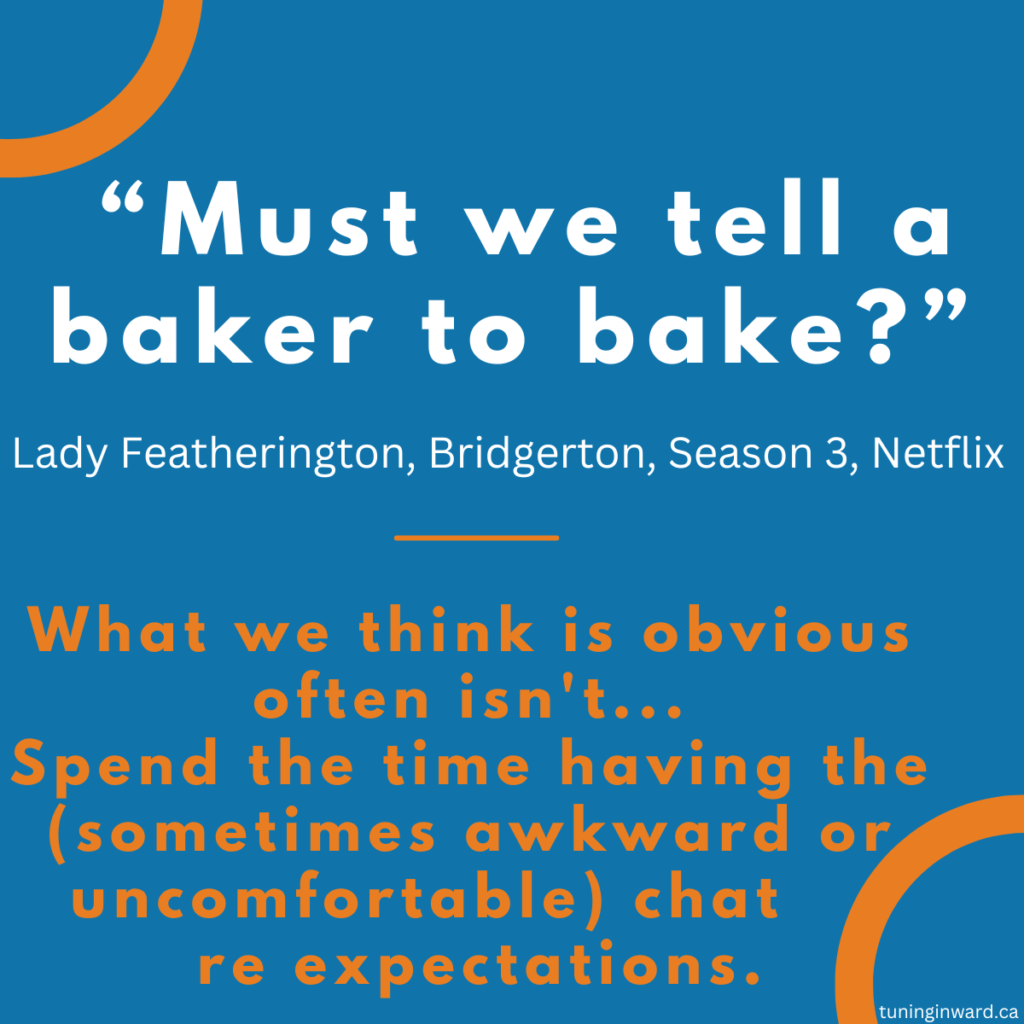
While encouraging two of her daughters to quickly produce an heir, Lady Featherington, in Netflix’s Bridgerton (Season 3, episode 1), exasperatedly references their recent marriages and then says: “Must we tell a baker to bake?” It is hilarious and perfect in the context of the show. It is also insightful professional/life advice that is a profound reminder for how we can better interact.

Just as it seems obvious that a baker’s primary role is to bake, we might assume certain tasks are equally obvious, whether in our personal or professional lives. But is it really so clear-cut?

Have you ever asked (or been asked) for something ‘asap’, in a ‘short’ memo, at a ‘high level’ but comprehensive, client or business-friendly? Or at home, have you asked for something to be cleaned, bought or fixed and found it wasn’t done at all how you had in mind?

Assumptions about expectations often result in work that doesn’t meet the required standards (or preferences) or timelines, or misaligned efforts and suboptimal outcomes, causing frustration on all sides.

We probably all know that it is important to have clear communication, but why is it so hard to do?

There are a number of reasons. The top three in my opinion are:

1 – Avoiding discomfort or awkwardness.

We generally are hesitant to have conversations we think may be difficult or create conflict – so many of us avoid them altogether.

2 – Worrying about our reputation.

Particularly at work, being perceived as both competent and likeable are key drivers of success and progression. It is sometimes a delicate balance when seeking clarification to maintain trust and confidence in our abilities. On the flip side, there is also a delicate balance between micromanaging and providing direction on scope and expectations.

3 – We don’t know what they don’t know.

As was clear in Bridgerton – what Lady Featherington thought her daughters knew and what they knew were different things. However, unless we are curious and explore potential disconnects, it is hard to know where the gaps may be.

Tools to help us clearly communicate expectations:

Here are a few ideas to hopefully make conversations about expectations easier, and less uncomfortable and awkward:

  1. ‘Share-back’ – if you’ve given the instructions, ask for the person to summarize the takeaway (or if you’ve received the request, offer to summarize your understanding). Often, this is an opportunity to see gaps and open the door for clarification.
  2. Be clear on constraints – are there budget, resource, timing, rule, page limitations?
  3. Examples – pointing to a previous speech, PowerPoint deck, memo or deliverable can provide a helpful precedent or starting point – even if it is to highlight what you want changed.
  4. Big picture – share (or make sure you understand) how this task fits in to the broader business objective. Is this going to be part of a presentation to the board, a pitch to the customer, shared publicly on the website? What is in intended result – to warn, to convince, to document, to brainstorm?
  5. Ask for clarification with intentional questions. Starting with open questions (like those starting with “how” or “what”) will often invite more details, and specific closed questions (e.g., Is Friday ok?) can help with confirming details.
  6. Listen. This often seems like something that goes without saying…and that is exactly what this article is challenging. Listening is a skill and gets better with intentional practice.

Incorporating Lady Featherington’s reminder into our personal and professional interactions can help us bridge gaps, foster better collaboration, and lead to more successful outcomes.

“Must we tell a baker to bake?” serves as a reminder that even the most seemingly obvious tasks require clear communication and mutual understanding.

Next time you find yourself assuming that something is obvious, take a step back and ask yourself: Have I communicated clearly?

Career Choices: Advancement, Transition, or Pivot?

In the professional world, there are three main choices when it comes to career paths: advancement, transition or pivot.

career choices
Photo by Vladislav Babienko on Unsplash

Advancement

Advancement is what is often described as the ‘traditional’ career path (though, it is becoming increasingly less and less common). It involves progressing to higher levels of responsibility, leadership, and influence within your current firm or company, often within the same area of specialty.

For example, as a lawyer or professional within a large firm, advancement would be getting from student to junior associate to senior associate to income partner to equity partner.

Transition

Instead of continuing on the same trajectory, transition refers to changing lanes in some way. Instead of a drastic change, it implies something related but different. This could involve moving to a different department, taking on a new type of project, or shifting to a related field. In a way, it can be seen as landing on a different runway but staying within the same airport.

For example, for a professional within a finance department, it could mean moving to a role in business development or sales within the same company. It could also mean that finance professional moving to another role in finance but in a different industry. In a legal context, it could mean moving from a firm to an in house environment.

Pivot

A career pivot involves a significant shift – where there is more that is different than the same. This might mean moving to a different industry or taking on a completely new type of role. Often, this involves re-training or adding a new area of expertise or focus.

For example, it could mean pivoting from a Human Resource Business Partner role to being legal counsel after completing training in law. It could also mean moving from a legal role to an operations or business development role, where conducting legal review or providing legal advice is no longer part of the job description.

Preparing for your next step:

While there are various ways to prepare for your next step, here are some ideas for consideration:

  1. Clearly define your professional aspirations
    • For some people, this may initially be defined by a particular title or role (e.g., general counsel). However, not all roles with the same title are equal or even refer to the same set of key tasks.
    • When defining your goals, consider honing in on your priorities. Reflect deeply on your personal and professional values and interests. What drives you? How do you want to spend your time? What impact would you like to make?
    • Get granular! Assess what aspects of your current role you enjoy and what aligns with your inner drivers and values. Where are the gaps? How important are those to your professional satisfaction? Use these to help create your criteria to assess any next step.
    • Take a staged approach, as there may be many potential paths to your destination. What might progress look like?
  2. Building your career narrative
    • Develop a clear story that links your past experiences to your desired role, emphasizing how each step demonstrates your impact and value.
    • So many skills are transferable to different contexts. Think about how to frame your abilities in a way that is relevant or needed, or perhaps even unique, to your desired role.
    • For some, it is often hard to remember details of everything we have done. Throughout your career journey, take time to document your accomplishments, key projects, even challenges you worked through. This will help remind you of what can be added to a potential narrative.
  3. Relationships
    • Relationships are key regardless of which career choice you are pursuing. A current colleague could be a future client, or boss. So could opposing counsel.
    • Cultivate relationships with others (at, above and below your current career level) who resonate with your values.

Your career journey is unique. Whether you decide to advance, transition, or pivot, each option demands distinct preparation and introspection.

At Tuning Inward Coaching and Consulting, we believe the best path for you involves tuning inward to your personal goals and values and leveraging your unique blend of skills and experience. Reach out if we can help you navigate your next step.